
Hotel de Batlo
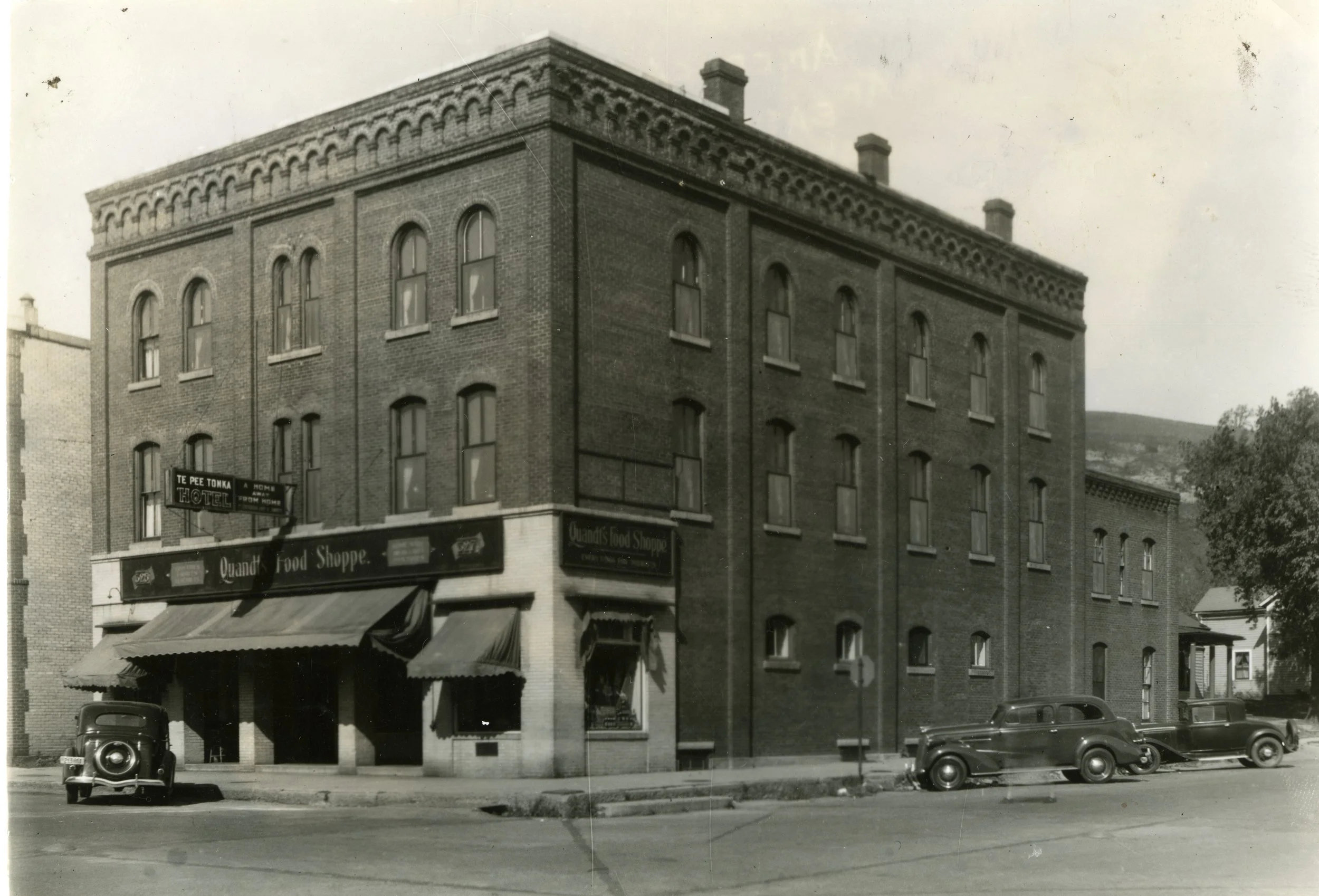
Hotel de Batlo in the 1930s or 1940s. At the time it was home to the Te Pee Tonka Hotel and Quandt’s Food Shoppe.
Built: 1874
Architect/Builder: Ambrose L. Clum
The fanfare that surrounded the 1875 St. James grand opening also served as the end of the Hotel de Batlo’s one-year reign as the finest hotel in Red Wing.
The Hotel de Batlo, also known as the Eagle House throughout the years, was designed by Ambrose L. Clum. Clum was a prolific architect in town, designing the Union Block, the apartments at 309 Plum Street, and St. John’s Lutheran Church. But he wasn’t just an architect.
He was also a salesman. Specifically, he peddled “Clum’s Liver Cathartic,” a medicine of his own invention, which would surely be viewed as snake oil by today’s standards. Clum invented the medicine in 1877, and convinced many of Red Wing’s big names, like T.B. Sheldon, S.B. Foot, and Charles Betcher to invest in the product. By the early 1880s the company was dissolved. Whether the public continued to believe in the efficacy of his product is not known.
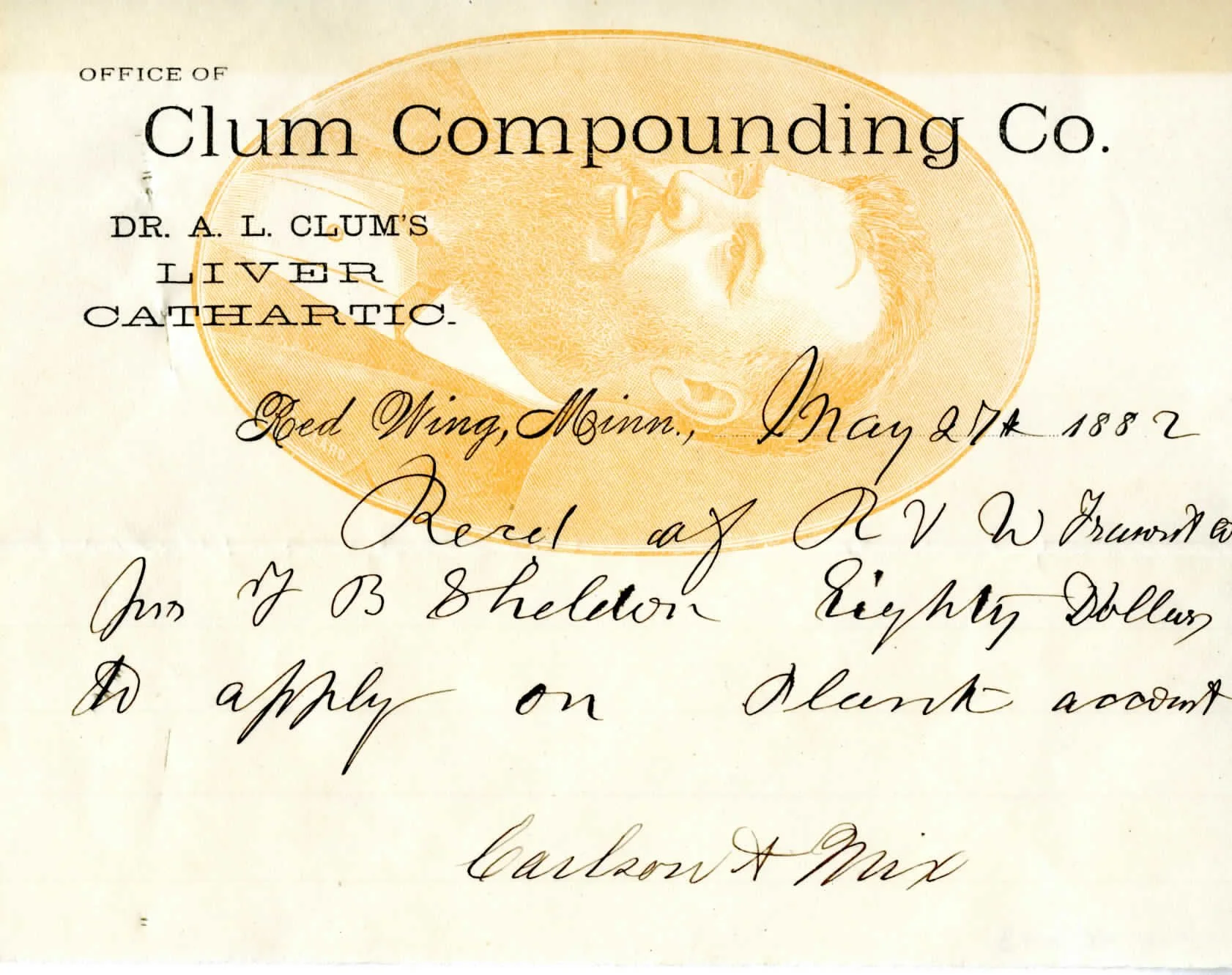
A receipt for Clum’s Liver Cathartic
Transitioning to a new career, in 1883, it was reported that Clum briefly pivoted into selling horse insurance.
But he soon returned to the medical sphere and moved to Indianapolis to attend medical school.
Clum eventually returned to Red Wing, and at the same time he began practicing law, which he had originally studied before his architecture career.
Before long, this led Clum into politics. In 1890, he ran for state senator, and in 1892 he ran for Judge of Probate in Goodhue County. That 1890 senate campaign was an early foray into yet another of Clum’s interests: suing people.
With his law degree, Clum acted as his own attorney in multiple cases. In 1890, he sued the Zumbrota News for libel after they published an editorial that referred to him as a “crank.” Clum reportedly feared that it tarnished his reputation. He eventually dropped the case when the Zumbrota editors offered a retraction. A few weeks after that, Clum withdrew from the senate race.
The next year he sued Goodhue County, saying he was owed money for constructing “a poor house.” This prompted the Zumbrota News to say about their old rival, “The Doctor is not happy unless he is the plaintiff in from one to a dozen law suits.”
Clum lost that case.
In 1893, Clum sued a Cannon Falls man, claiming he owed him money for a bottle of Great American Germicide and Bactericide. In court, Clum, The Advance Sun reported, “roasted” the Cannon Falls man “over a devouring flame of oratory until the very hair and whiskers of the jury curled from the heat.”
Clum won the case and was awarded $1.
Soon after these trials, Clum relocated to Minneapolis where he established himself as a tumor and cancer specialist. The National Health Journal even gave him their seal of approval. With this confidence, Clum took to advertising himself as “The Greatest Doctor on Earth.”
If Clum truly were the Greatest Doctor on Earth, he’d likely be remembered for that today. Instead, it is his architecture that has stood the test of time.
